What Rust Knows: The Science of Reading Infrastructure Failure in the Language of Decay
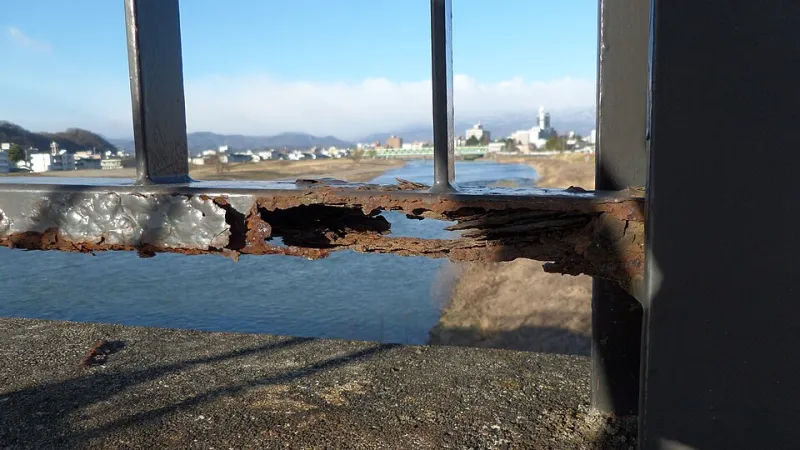
Photo: Yoshutten, CC0, via Wikimedia Commons
The Fern Hollow Bridge in Pittsburgh collapsed on a January morning in 2022, hours before President Biden arrived in the city to discuss infrastructure funding. No one was killed, but several people were injured and the incident became a vivid symbol of a problem that engineers and policy analysts had been documenting for years: the United States is living on borrowed structural time. The American Society of Civil Engineers gave the nation's infrastructure a C-minus grade in its 2021 report card, with bridges, water mains, and energy transmission systems among the most concerning categories. Deferred maintenance, chronic underfunding, and inspection systems that rely heavily on periodic visual surveys have combined to create a landscape of uncertainty about which structures are genuinely safe and which are quietly approaching the edge of failure.
A growing field of research is proposing a fundamentally different way to answer that question—not by inspecting structures more frequently, but by teaching the structures to report their own condition continuously, using the very chemistry of their deterioration as the signal.
The Physics of Failure as a Diagnostic Language
Materials scientists have long understood that corrosion and structural fatigue are not random events. They follow predictable physical and electrochemical laws. Steel corrodes in patterns governed by moisture exposure, chloride concentration, pH gradients, and mechanical stress. Concrete develops microcracks along pathways determined by aggregate composition, load history, and thermal cycling. Pipeline walls thin according to fluid chemistry, flow velocity, and weld geometry.
For most of engineering history, this predictability was exploited retrospectively—used to explain failures after they occurred or to set conservative inspection intervals before they did. What researchers are now pursuing is the use of that same physical predictability in real time, deploying sensors and analytical models that translate the ongoing process of degradation into actionable forecasts of remaining structural life.
The conceptual shift is significant. Rather than treating a corroding bridge beam as a problem to be detected, this approach treats it as an instrument—one that is continuously broadcasting information about its own internal state, provided you have the means to listen.
Embedding Intelligence in Decay
The enabling technologies for this approach have converged from several directions over the past decade. Advances in electrochemical sensing have produced miniaturized corrosion probes capable of measuring corrosion rate, corrosion potential, and ionic concentration in real time, at costs low enough to justify deployment across large structures. Fiber optic strain sensing can detect the micro-deformations that precede visible cracking with sub-millimeter resolution across spans of hundreds of feet. Acoustic emission monitoring captures the ultrasonic signals generated when materials undergo internal fracture—sounds inaudible to human ears that nonetheless carry precise information about the location and severity of structural damage.
Researchers at Northwestern University, Purdue, and the University of California San Diego, among others, are working on integrated systems that combine these sensing modalities with machine learning algorithms trained to distinguish meaningful degradation signatures from environmental noise. The challenge is substantial: a real-world bridge or pipeline generates an enormous volume of sensor data, most of which reflects normal operational variation rather than progressive failure. Teaching a model to identify the specific patterns that indicate accelerating deterioration requires both high-quality labeled training data and robust feature engineering.
Federal agencies including the Department of Transportation and the Department of Energy have funded multiple research programs in this space, recognizing that the inspection workforce and budget required to manually survey America's infrastructure inventory on adequate schedules simply does not exist and cannot be assembled quickly enough to address the current backlog.
Pipelines, Bridges, and Power Infrastructure
The applications vary considerably by infrastructure type, and each presents distinct sensing and modeling challenges.
For buried pipelines—the network of natural gas, petroleum, and water transmission lines that underlies the American landscape—external corrosion is the dominant failure mode, and the inaccessibility of the pipe wall makes conventional inspection both expensive and infrequent. Several research groups and pipeline operators are piloting distributed fiber optic sensing systems that can detect the strain signatures of corrosion-related wall thinning along pipeline segments miles in length. When integrated with soil chemistry data and historical leak records, these systems can generate probabilistic failure maps that prioritize maintenance resources with far greater precision than time-based inspection schedules.
Bridge infrastructure presents a different problem set. Steel girders and reinforced concrete decks are exposed to a complex combination of mechanical loading, thermal stress, and chemical attack from road salt and moisture. Researchers at the University of Michigan and Carnegie Mellon have developed sensor packages that can be bonded directly to structural steel, measuring corrosion rate, strain, and temperature simultaneously while transmitting data wirelessly to cloud-based analysis platforms. Pilot deployments on bridges in the Midwest have demonstrated that these systems can detect the onset of accelerated corrosion—the precursor to structural compromise—months before it becomes visible during a routine inspection.
Power transmission infrastructure, including high-voltage towers and substation equipment, is increasingly being instrumented with corrosion and vibration monitoring systems following a series of high-profile failures that caused extended outages. Utilities in California and Texas, both states that have experienced the consequences of infrastructure failure at scale, have been among the early adopters of sensor-based degradation monitoring for transmission assets.
From Data to Decision
Collecting degradation data is only half the problem. Converting it into actionable maintenance decisions requires analytical frameworks that can translate sensor readings into estimates of remaining structural life and failure probability—outputs that infrastructure managers can use to allocate limited repair budgets and schedule interventions before emergencies arise.
This is where the field is developing most rapidly. Machine learning models trained on historical failure data, combined with physics-based simulation of material behavior under measured degradation conditions, are beginning to produce forecasts with enough accuracy to influence real maintenance planning. The Federal Highway Administration has been working with several state departments of transportation to pilot decision-support tools that integrate sensor data from instrumented bridges with structural models and maintenance cost data, generating prioritized intervention recommendations.
The economic case is compelling. Emergency repairs following structural failures cost, on average, several times more than planned maintenance interventions. Reducing unplanned failures by even a modest percentage across the national infrastructure inventory would produce savings that dwarf the cost of deploying monitoring systems at scale.
Infrastructure Intelligence by 2030
The vision that emerges from current research trajectories is of an infrastructure network that is, in a meaningful sense, self-aware—continuously reporting its own condition, flagging deterioration before it becomes dangerous, and providing the data necessary to make rational decisions about where limited maintenance resources will have the greatest impact.
Reaching that vision by 2030 will require not only continued technical development but significant changes in how infrastructure data is collected, owned, and shared. Many of the most valuable insights emerge from aggregating sensor data across multiple structures and operators—patterns that are invisible at the level of a single bridge or pipeline segment become apparent when analyzed across a network. Building the data-sharing agreements, privacy frameworks, and interoperability standards to make that aggregation possible is a governance challenge as much as a technical one.
The science of reading failure in the language of decay is mature enough to be deployed today, in targeted applications across the most critical and vulnerable elements of American infrastructure. The question for the decade ahead is whether the institutional will exists to deploy it at the scale the problem demands.