Growing Up: 7 Vertical Farming Breakthroughs Quietly Rewiring America's Food Future
Growing Up: 7 Vertical Farming Breakthroughs Quietly Rewiring America's Food Future
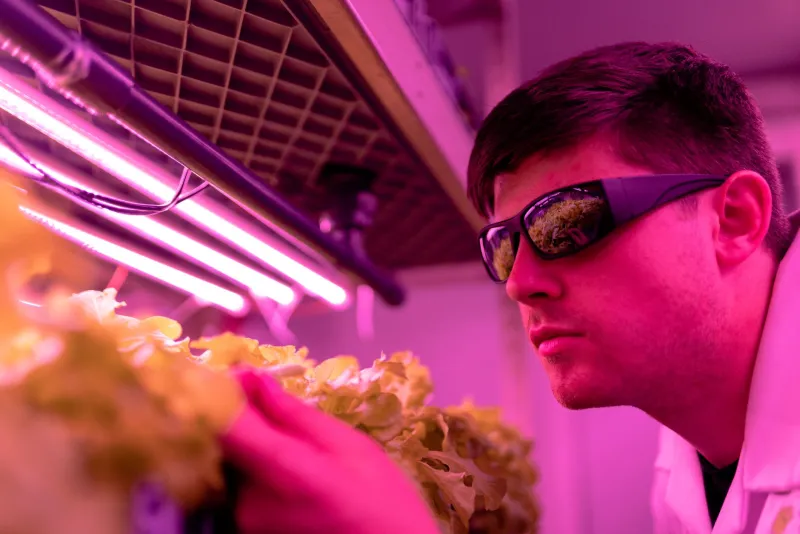
The vertical farming industry has had a complicated relationship with credibility. Splashy funding announcements, dramatic facility openings, and breathless coverage of lettuce grown under pink LED lights gave way, in several high-profile cases, to equally dramatic financial collapses. AeroFarms filed for bankruptcy in 2023. AppHarvest followed. The narrative of disruption met the arithmetic of energy costs and unit economics, and the arithmetic won.
But the story does not end there — and at ARK 2030, we think the more interesting chapter is just beginning. Beneath the wreckage of first-generation hype, a quieter cohort of researchers, engineers, and entrepreneurs has been solving the hard problems. What follows is an honest assessment of seven advances that are genuinely reshaping controlled-environment agriculture — what works, what scales, and what still requires scrutiny.
1. AI-Driven Crop Optimization: From Guesswork to Precision
The most transformative shift in vertical farming over the past three years has not been a new piece of hardware. It has been software.
Companies like Plenty, which operates a large-scale indoor facility in Compton, California, and 80 Acres Farms, headquartered in Cincinnati, Ohio, have deployed machine-learning systems that continuously monitor plant physiology — measuring variables including leaf temperature, chlorophyll fluorescence, stomatal conductance, and growth rate — and adjust lighting spectra, CO₂ concentration, nutrient delivery, and humidity in real time. The result is what agronomists call "dynamic cultivation": a growing environment that adapts to the plant rather than imposing a fixed protocol.
In controlled trials, AI-optimized systems at 80 Acres have demonstrated yield improvements of 20 to 30 percent over static cultivation protocols for certain crops, with simultaneous reductions in water and fertilizer consumption. The scalability of software, unlike hardware, does not require rebuilding a facility — it can be deployed as an update. That asymmetry is significant.
Verdict: Genuinely scalable. Already commercial.
2. Next-Generation LED Lighting: Tuning the Sun
Lighting has historically been vertical farming's most punishing cost center, accounting for 25 to 40 percent of operating expenses in many facilities. The LED technology that enabled the industry's first wave was efficient relative to older alternatives, but it remained expensive and energetically demanding at scale.
Researchers at Purdue University's Department of Horticulture and Landscape Architecture, along with commercial partners including Signify (formerly Philips Lighting), have developed narrowband LED arrays capable of delivering specific photon wavelengths — deep red, far red, blue — at efficiencies exceeding 70 percent photon conversion. More significantly, new understanding of photomorphogenesis (the way plants respond to light quality, not just quantity) has allowed growers to manipulate plant architecture, nutritional density, and flavor profiles through targeted spectrum management.
Far-red light supplementation, for instance, has been shown to accelerate lettuce and spinach growth by activating the shade-avoidance response without the energy penalty of simply increasing overall light intensity. Several commercial growers in New Jersey and Michigan have integrated this approach into production protocols.
Verdict: Proven technology with meaningful cost implications. Adoption accelerating.
3. Mycelium-Based Growing Substrates: Rethinking the Root Zone
This is one of the more genuinely novel developments in the space, and also one of the least widely understood. Traditional hydroponic and aeroponic systems deliver nutrients directly to plant roots through water or mist — an approach that works but strips away the microbial complexity that characterizes healthy soil ecosystems.
Researchers at Cornell University's School of Integrative Plant Science and the startup Mycocycle (based in Illinois) have been developing mycelium-inoculated growing substrates that replicate aspects of the mycorrhizal networks found in natural soil. In preliminary studies, plants grown in mycelium-integrated substrates demonstrate improved phosphorus uptake, stronger disease resistance, and in some cases measurably higher concentrations of secondary metabolites — the compounds responsible for flavor, aroma, and many of the nutritional properties that consumers associate with fresh produce.
The commercial pathway for mycelium substrates is less mature than other technologies on this list. Production costs remain elevated, and integrating living fungal networks into highly controlled growing environments introduces biological variables that facility operators are still learning to manage. This one warrants continued attention but honest caution.
Verdict: Promising, early-stage. Not yet scalable at commercial volume.
4. Autonomous Robotics for Seeding, Transplanting, and Harvest
Labor costs represent the second major structural challenge in vertical farming after energy. In a fully stacked growing facility, the physical tasks of seeding, transplanting seedlings, monitoring plant health, and harvesting mature crops require either significant human labor or significant capital investment in automation — and until recently, the robotics capable of handling the fine motor demands of plant handling were prohibitively expensive.
Iron Ox, a San Francisco-based company, has built a fully autonomous growing system in which robotic arms and mobile platforms manage the entire cultivation workflow with minimal human intervention. The company's Grover robot platform — designed specifically for the spatial constraints of modular indoor growing systems — can handle leafy greens and herbs with a damage rate below two percent, a threshold competitive with skilled human harvesters.
Beyond Iron Ox, university engineering programs at Carnegie Mellon and Georgia Tech are advancing soft-robotics research specifically targeted at agricultural applications — grippers and end-effectors designed to handle delicate plant tissue without bruising. As component costs continue to decline, the economic case for robotic automation in large-scale vertical facilities strengthens considerably.
Verdict: Commercially viable at scale. Adoption will accelerate as hardware costs fall.
5. Renewable Energy Integration and On-Site Power Generation
The energy problem in vertical farming is not unsolvable — it is a function of where and how power is sourced. The facilities that struggled financially in the industry's first wave were, in many cases, purchasing grid electricity at retail rates in high-cost markets. The facilities being built in 2024 and beyond are approaching energy differently.
Appalachian Power's partnership with greenhouse operators in Virginia, and a growing number of vertical farms co-located with solar installations across the Southwest, represent a structural shift: treating energy generation as part of the agricultural system rather than an external input. Gotham Greens, which operates facilities in Chicago, New York, and several other US cities, has integrated rooftop solar and LED efficiency optimization to reduce its energy intensity per pound of produce by approximately 40 percent over five years.
More experimentally, researchers at the National Renewable Energy Laboratory (NREL) in Golden, Colorado, are modeling hybrid systems in which waste heat from on-site solar inverters and battery storage is captured and redirected into climate control for growing spaces — a form of energy cascading that could meaningfully reduce net consumption.
Verdict: Directionally sound. Economics depend heavily on local energy markets and policy environment.
6. Crop Diversification Beyond Leafy Greens
For most of its commercial history, vertical farming has been a leafy greens business — lettuce, spinach, arugula, herbs. These crops grow quickly, require relatively modest light intensity, and command retail price premiums sufficient to support indoor production economics. Staple crops — wheat, corn, soybeans — have remained firmly in the field.
That boundary is beginning to shift, though carefully. Bowery Farming has published results from strawberry cultivation trials in controlled environments. Researchers at the University of Arizona's Controlled Environment Agriculture Center have successfully cultivated dwarf wheat varieties under indoor conditions with yields per square foot competitive with field production. Perhaps most significantly, indoor tomato production — long practiced in greenhouse settings but now moving toward fully stacked vertical configurations — is expanding rapidly in the US Midwest, with facilities in Ohio and Indiana supplying regional grocery chains.
The economic and agronomic challenges of diversifying beyond leafy greens remain substantial. Fruiting crops require more light, more space, and more complex pollination management. But the direction of travel is clear, and the implications for climate resilience in American food systems are significant.
Verdict: Early commercial traction in select crops. Full diversification is a 2030-horizon story.
7. Data-Sharing Platforms and Open-Source Cultivation Protocols
The least glamorous item on this list may ultimately be the most consequential. One of the structural inefficiencies in vertical farming's first decade was that each operator developed cultivation protocols — lighting schedules, nutrient formulations, environmental setpoints — in isolation, treating that knowledge as proprietary. The result was widespread duplication of effort and slow collective learning.
A consortium of US land-grant universities, coordinated through the USDA's National Institute of Food and Agriculture (NIFA), has been developing open-source cultivation databases that allow growers to share performance data — anonymized and aggregated — across facilities and crop types. The initiative, still in its early phases, draws conceptually on the open-source software movement: the idea that shared infrastructure accelerates innovation faster than proprietary competition.
Several commercial operators, including Little Leaf Farms in Massachusetts, have begun contributing data to shared research platforms in exchange for access to aggregated benchmarking information. If this model scales, it could compress the learning curve for new entrants dramatically and accelerate the industry's path to genuine economic sustainability.
Verdict: Structurally important. Underappreciated. Watch this space.
The Honest Summary
Vertical farming will not feed America by 2030. The land, the infrastructure, and the economics do not support that outcome, and anyone claiming otherwise is selling something. What controlled-environment agriculture can do — and is doing, with increasing competence — is provide climate-resilient production capacity for specific, high-value crop categories in specific geographies, reducing supply chain vulnerability for fresh produce in regions where field agriculture faces growing climate risk.
The breakthroughs on this list are real. Their scalability varies. The industry's credibility depends on matching ambition to evidence — and on building the kind of durable, unglamorous infrastructure that actually feeds people. That work is underway, and it matters.